Architecture
The Pipeline
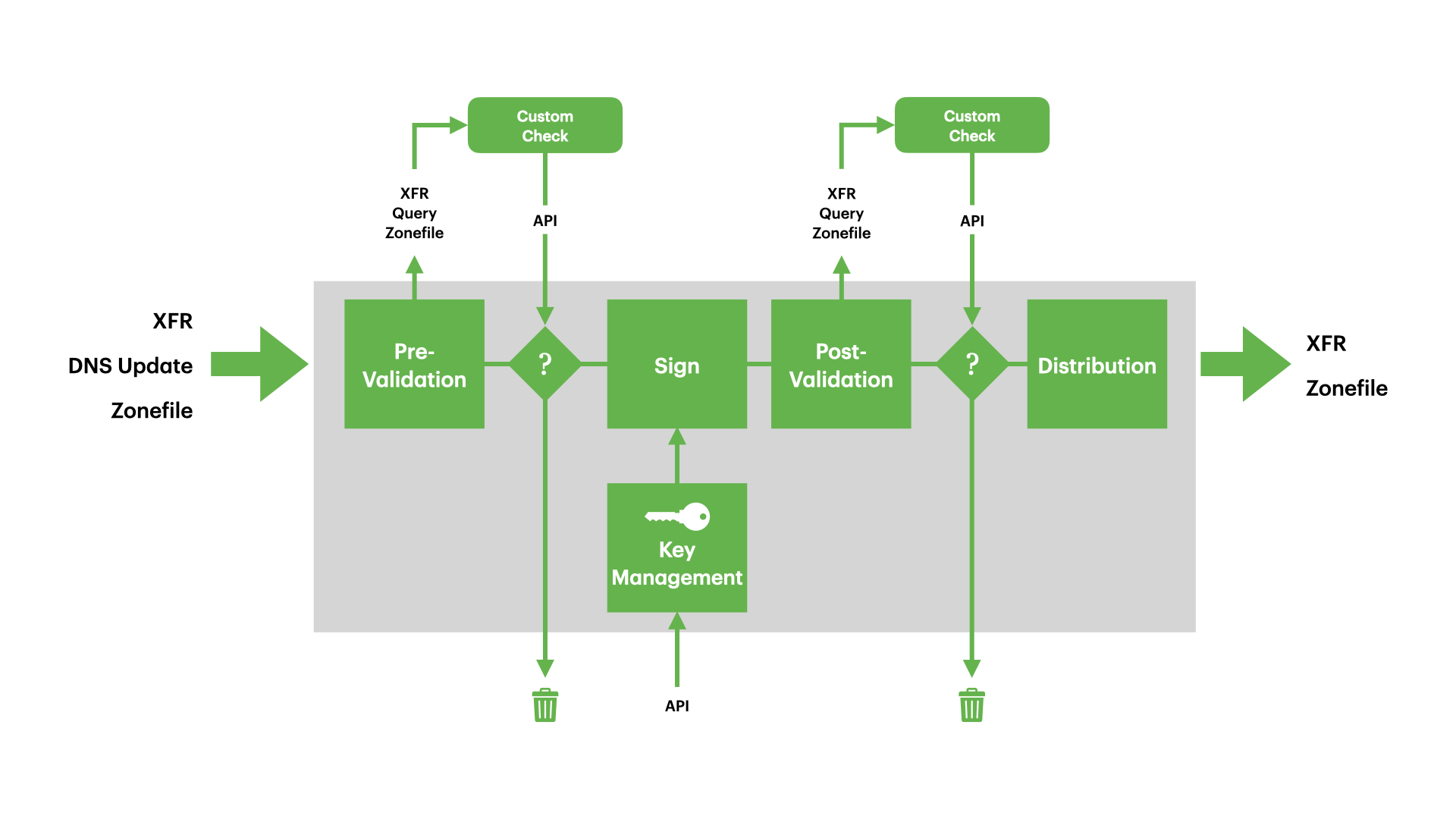
Zone changes are said to cascade through a pipeline consisting of several stages:
- Loading
  - Approving
    - Signing
      - Approving
        - Publishing
Robustness
Cascade is written in the Rust programming language making it significantly less likely to crash or suffer from memory safety issues, and at the same time making it easier to leverage the higher core count of modern computers via Rust’s “fearless concurrency” when needed.
Cascade outsources PKCS#11 module loading to a separate kmip2pkcs11 daemon to avoid running untrusted 3rd party code inside the main Cascade process also thereby eliminating another source of potential instability and unpredictable behaviour and resource usage.
Flexible Signing
Cascade does not require an HSM to operate. While it is common practice to secure cryptographic key material using an HSM, not all operators use an HSM. Cascade is able to use OpenSSL and/or ring software cryptography to generate signing keys and to cryptographically sign DNS RRSET data, storing the generated keys in on-disk files.
For operators wishing to use a HSM Cascade can connect directly to KMIP compatible HSMs, or to PKCS#11 compatible HSMs via our kmip2pkcs11 daemon which is installed automatically as part of our Cascade packages.
Bespoke Zone Verification
Cascade supports optional verification of your zone data at two critical stages: verification of the unsigned zone, and verification of the signed zone.
In both cases verification consists of executing an operator supplied script or application which can verify the zone using whatever mechanisms are required to satisfy your policy.
Verification of the zone can be done by retrieving the zone using the DNS XFR protocol from dedicated “review” nameservers within Cascade, either verifying the zone directly or writing the zone to disk for verification by tools that only support working with files.
On completion of the verification process, approval or rejection is signalled back to Cascade via the script exit code.
Rejecting a zone “soft” halts the Cascade pipeline for the zone, preventing it from cascading further down the pipeline, but allowing a newer version of the zone to be completely processed (unless that too should fail verification).
Serious errors in the pipeline may result in a “hard” halt for the pipeline of a zone preventing any further processing of that zone for the current and future versions of the zone until an operator manually resumes the pipeline.
Daemon Processes
Unlike OpenDNSSEC, Cascade does not run as two separate daemons (the Enforcer and the Signer) but instead is able to act entirely on its own, as long as on-disk signing keys are permitted by your organizational security policy or when using a KMIP compatible HSM.
If required a KMIP or PKCS#11 compatible HSM can be used instead of on-disk keys. In the case of a KMIP compatible HSM there will still be only a single Cascade daemon. If using a PKCS#11 compatible HSM you will also need to run the kmip2pksc11 daemon which will receive KMIP TCP TLS requests from Cascade and convert them into operations to execute against a loaded PKCS#11 module.
In this latter setup it may appear similar to the architecture of OpenDNSSEC in that it has two processes, one daemon acting as a nameserver and issuing signing instructions to the other daemon.
However, the resemblance is only slight, as there are no shared on-disk configuration files via which the daemons communicate, and thus no shared on-disk state which can become out of sync between daemons or vs the in-memory view of the world possessed by each daemon.
This is because with Cascade the second daemon, kmip2pkcs11, is much simpler than the OpenDNSEC signer daemon, it only receives and executes signing requests on a per DNS RRSET basis, it is not responsible for the entire zone and exists to shield the main Cascade daemon from the risks posed by PKCS#11.
OpenDNSSEC is not able to communicate directly from the Enforcer to a remotely running Signer, it is only able to write files to disk and then expects the operator to correctly make the appropriate files available to the signer in the expected location such that they form a logically consistent set. With Cascade the communication between daemon processes uses the KMIP TCP TLS protocol whether daemons are local or running on separate servers, using a direct encrypted connection to communicate.
Managing State
Cascade stores its state in on-disk files in JSON format, by default at various locations under a single parent directory. No additional database software is required, state is human readable and easily backed up.
Some configuration is done via the Cascade CLI (adding zones and HSMs), other configuration is done by editing on-disk policy and application configuration files and instructing the Cascade daemon via the CLI to reload them.
The Cascade daemon updates its on-disk state files periodically, and when signalled to stop, reloading them on next start.
As Cascade outsources PKCS#11 support to kmip2pkcs11 it does not require access to PKCS#11 related configuration files or other PKCS#11 module dependencies.